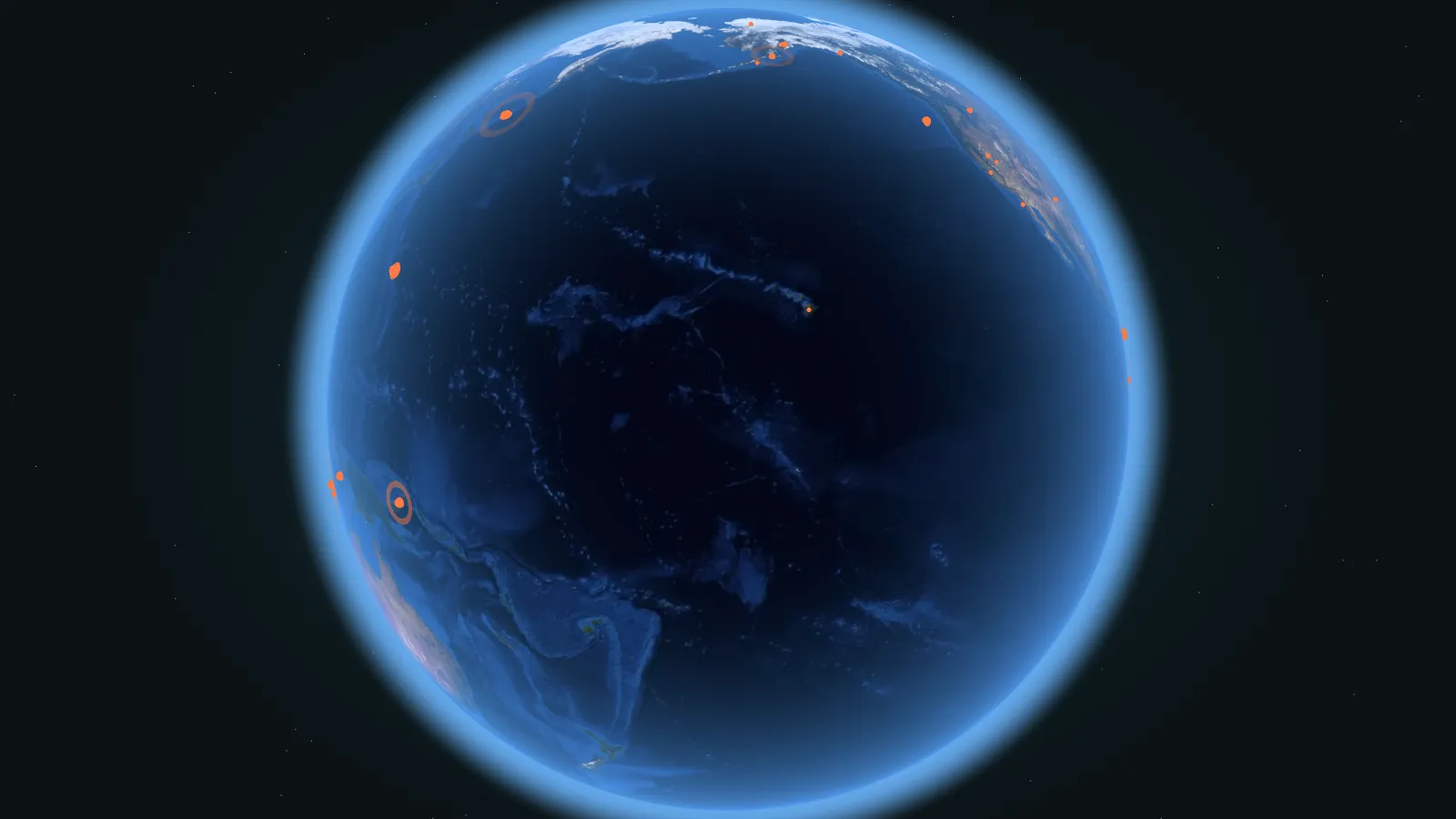
Trace the edge of the Pacific Ocean with your finger, from New Zealand up past Japan, across to Alaska and down the coasts of North and South America. You have just followed the Ring of Fire, a horseshoe-shaped belt about 40,000 kilometers long where Earth is at its most restless.
Around 80 to 90 percent of the world's earthquakes happen here, including most of the very largest. The ring also holds roughly three quarters of Earth's active and dormant volcanoes.
Where is the Ring of Fire?
The ring is not a perfect circle. It is a chain of volcanoes, trenches and fault lines that loops around most of the Pacific Ocean. Countries and regions along it include:
- New Zealand
- Tonga and Fiji
- Papua New Guinea
- Parts of Indonesia
- The Philippines
- Japan
- Russia's Kamchatka Peninsula
- Alaska and the Aleutian Islands
- Western Canada and the US West Coast
- Mexico and Central America
- Colombia, Ecuador and Peru
- Chile
Why are there so many earthquakes and volcanoes?
The Pacific Ocean sits mostly on the Pacific Plate, surrounded by smaller ocean plates like the Nazca, Cocos, Juan de Fuca and Philippine Sea plates. All around the edge, these ocean plates are colliding with neighboring plates and sinking beneath them. Geologists call this subduction, and the places where it happens are subduction zones.
Subduction explains the ring's three signatures:
- Earthquakes. The sinking plate scrapes and sticks against the plate above it. When it suddenly slips, the ground shakes. The biggest earthquakes ever measured all happened at subduction zones.
- Volcanoes. As the ocean plate sinks deeper, water trapped in its rocks is released into the hot mantle above. The water lowers the melting point of the rock, creating magma that rises to form chains of volcanoes.
- Deep trenches. Where one plate bends down under another, the seafloor drops into a trench. The Mariana Trench in the western Pacific reaches nearly 11,000 meters, the deepest place in the ocean.
For the bigger picture of how plates move, read plate tectonics for kids.
Famous Ring of Fire events
1960, Chile. The Valdivia earthquake measured magnitude 9.5, the strongest earthquake ever recorded. Its tsunami crossed the entire Pacific and reached Hawaii and Japan.
1964, Alaska. A magnitude 9.2 earthquake shook southern Alaska for about four minutes, the most powerful in North American history.
1980, United States. Mount St. Helens in Washington State erupted sideways, removing the top of the mountain and flattening forests for miles.
1991, the Philippines. Mount Pinatubo's eruption sent so much ash and gas into the sky that global temperatures dropped by around half a degree Celsius for a year or two.
2011, Japan. The magnitude 9.0 to 9.1 Tohoku earthquake triggered a tsunami that caused enormous damage along Japan's northeast coast.
How people live with the Ring of Fire
Hundreds of millions of people live along the ring, in cities like Tokyo, Manila, Jakarta, Los Angeles, Mexico City, Lima and Santiago. Countries have learned to prepare:
- Earthquake-resistant buildings that flex instead of breaking, required by building codes in places like Japan and Chile.
- Early warning systems that detect the first, faster seismic waves and send alerts seconds before strong shaking arrives.
- Tsunami warning centers that track ocean waves across the Pacific and warn coastal communities.
- Regular drills in schools, so students know to drop, cover and hold on.
Common myths
"The Ring of Fire is a ring of lava."
No. It is a belt of separate volcanoes and fault lines, mostly hundreds of kilometers apart. Most of the time, most of them are quiet.
"Hawaii is part of the Ring of Fire."
Hawaii's volcanoes are in the middle of the Pacific Plate, not at its edge. They form over a hotspot, a plume of hot rock rising from deep in the mantle. Iceland, too, is outside the ring: it sits on the Mid-Atlantic Ridge.
"The Ring of Fire is getting more active."
The number of large earthquakes changes from year to year, which can make a busy year feel unusual. Long-term records do not show the ring becoming more active overall.
Quick answers
How long is the Ring of Fire?
About 40,000 kilometers, roughly the same as the distance around Earth at the equator.
How many volcanoes are on the Ring of Fire?
More than 450, around three quarters of the world's active and dormant volcanoes.
Which country has the most earthquakes?
Japan and Indonesia record some of the highest numbers of earthquakes in the world, because both sit where several plates meet.