Right now, about 400 kilometers above your head, the International Space Station is racing around the planet at roughly 28,000 kilometers per hour. That is about 7.7 kilometers every second, fast enough to fly from London to New York in around 12 minutes.
The ISS in numbers
About 28,000 km/hAverage speed, around 17,500 miles per hour
About 400-420 kmHeight above Earth's surface
About 92 minutesTime for one trip around Earth
About 16Sunrises and sunsets the crew sees every day
The station is roughly the length of an American football field from end to end, and astronauts have lived on board continuously since November 2000.
Why does the ISS have to go so fast?
Here is the surprising part: gravity at the height of the ISS is still about 90 percent as strong as it is on the ground. The station is not floating above gravity. It is falling.
Isaac Newton described it with a thought experiment. Imagine a cannon on top of a very tall mountain. Fire a cannonball gently and it curves down to the ground nearby. Fire it faster and it lands farther away. Fire it fast enough, and the ground curves away beneath it as quickly as it falls. The cannonball keeps falling forever without ever landing. That is an orbit.
At the height of the ISS, "fast enough" works out to about 7.7 kilometers per second. Any slower and the station would gradually spiral down into the atmosphere. Astronauts float inside because they are falling around Earth together with the station, so nothing pushes them against the floor.
Why one orbit takes about 90 minutes
You can work this out with numbers students already know:
- Earth's radius is about 6,371 km. Add the station's height of about 420 km, and the orbit's radius is about 6,791 km.
- The distance around a circle is 2 x pi x radius, so one orbit is about 2 x 3.14 x 6,791, or roughly 42,700 km.
- Divide by the speed: 42,700 km / 27,600 km per hour is about 1.55 hours.
- 1.55 hours is about 93 minutes.
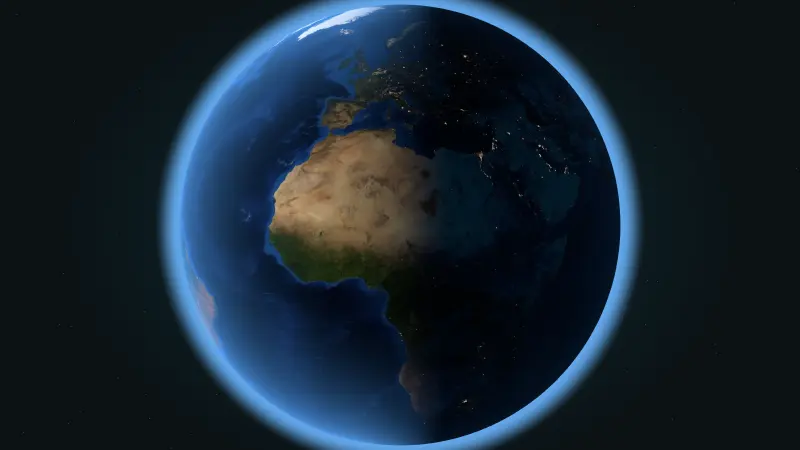
That gives about 15.5 orbits every day, which is why the crew sees around 16 sunrises and 16 sunsets in every 24 hours. Each orbit crosses the line between day and night twice. To see how that line moves, read why it is day here and night there.
Why its path looks like a wave on a map
On a flat world map, the station's track looks like a snake or a wave. Two things cause this:
- The orbit is tilted. The ISS orbits at an angle of 51.6 degrees to the equator, so it swings as far north as about 51.6 degrees north and as far south as 51.6 degrees south. That covers the areas where around 90 percent of people live.
- Earth turns underneath it. During one 92-minute orbit, Earth rotates about 23 degrees to the east. So each new pass is shifted west compared with the one before.
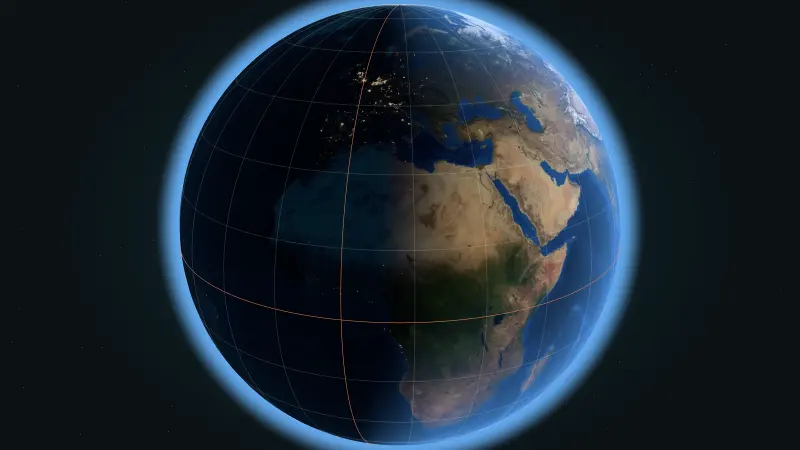
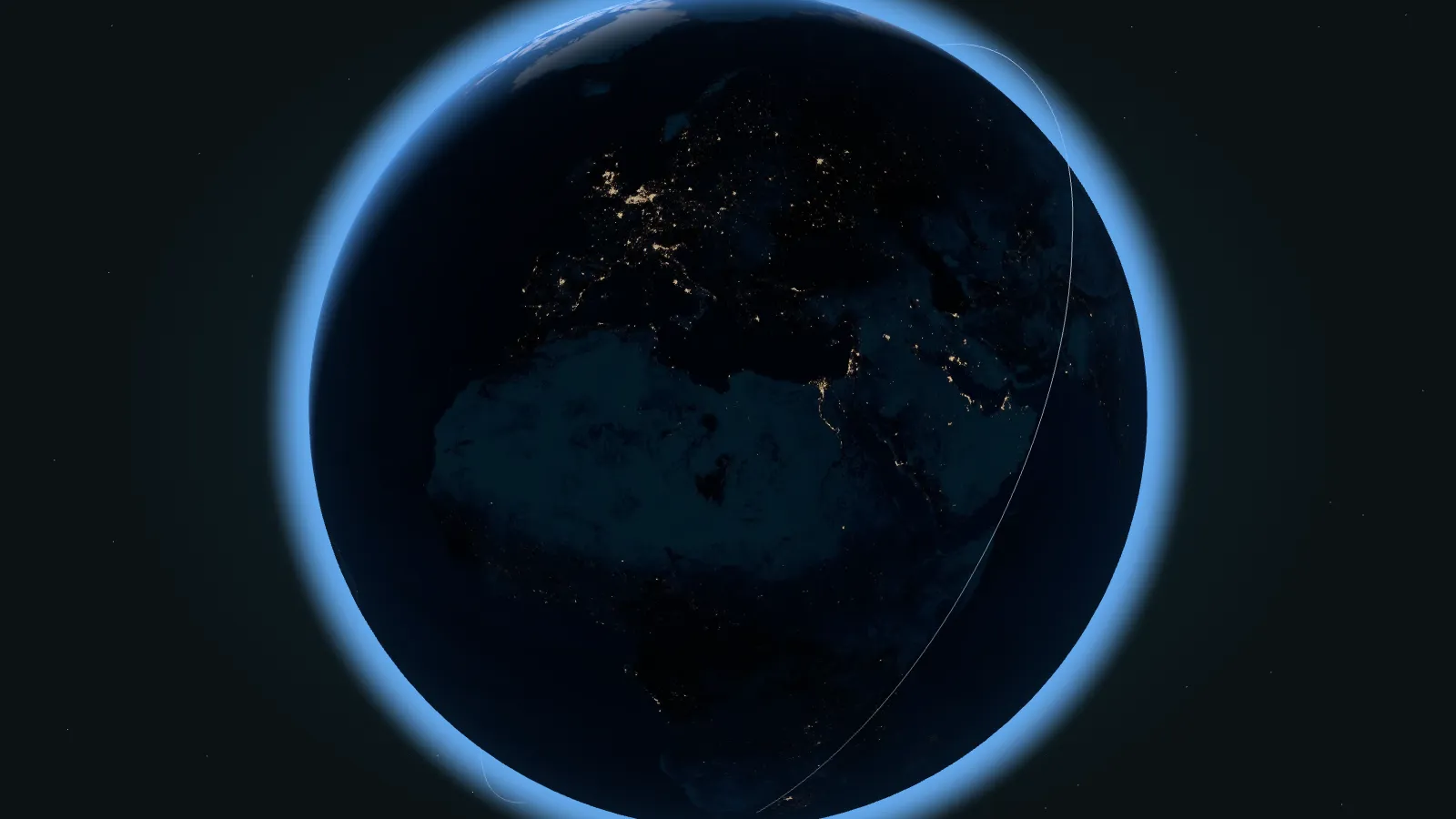
On our 3D globe the same path appears as a smooth tilted ring, which is a good moment to show students why flat maps distort the world.
How to see the ISS with your own eyes
NASA calls the ISS the third-brightest object in the sky, after the Sun and the Moon. You do not need a telescope to see it.
- Look around dawn or dusk. You need to be in darkness while the station, high above, is still lit by the Sun.
- Look for a steady, bright point moving smoothly across the sky. Planes blink; the ISS does not.
- Be quick. A good pass lasts only a few minutes from horizon to horizon.
- Check the schedule. NASA's free Spot the Station service lists visible passes for your town.
Questions students ask
Does the ISS ever slow down?
Very slightly. Even at 400 km there is a trace of atmosphere that drags on the station, so it slowly loses height. Every so often, engines give it a push called a reboost to raise its orbit again.
Can astronauts see my country?
Yes, if it is under the station's path and not covered by clouds. Astronauts regularly photograph cities, rivers, deserts and city lights at night.
How long will the ISS stay in space?
Current plans aim to retire the station around 2030 and guide it safely into a remote part of the Pacific Ocean.
Why does the speed on this page change a little?
The station's orbit is not a perfect circle, and its height changes slightly. It moves a little faster when it is lower and a little slower when it is higher.