When students in Sofia are packing up after school, children in Tokyo are getting ready for bed and kids in New York are just starting their morning lessons. Same planet, same moment, completely different times of day. The reason is simple, and it is one of the most satisfying things to watch on a globe.
Earth spins, the Sun stays put
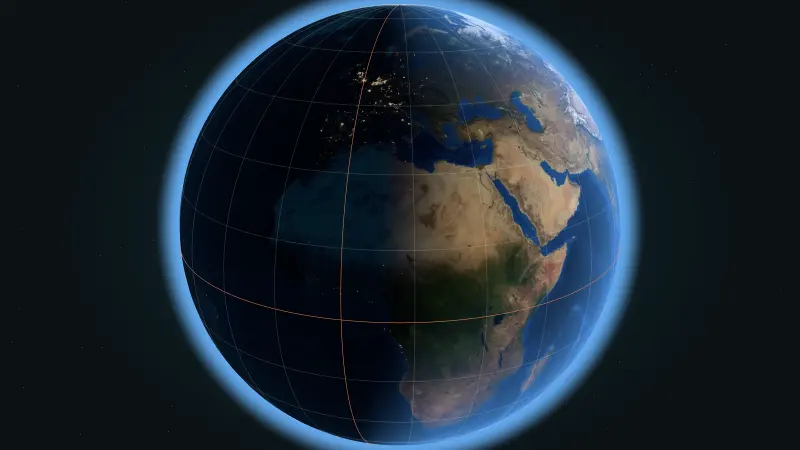
The Sun lights up one half of Earth at a time, the same way a lamp lights one side of a ball. Earth spins on its axis once about every 24 hours, so every place on the planet takes turns facing the Sun (day) and facing away from it (night).
Earth spins toward the east. That is why the Sun appears to rise in the east and set in the west, and why countries farther east start their day earlier.
The terminator: the line between day and night
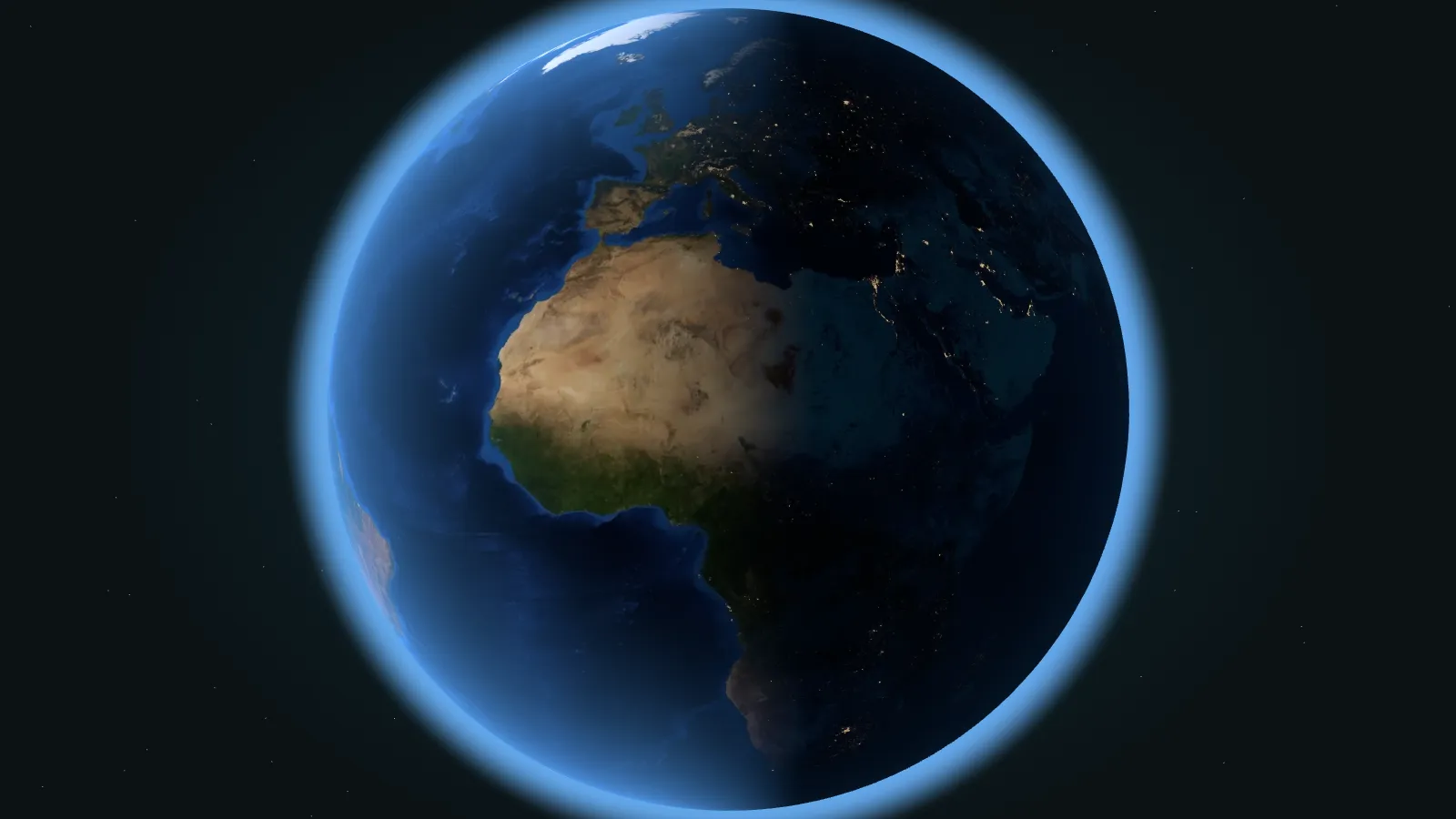
The edge between the sunlit half and the dark half has a dramatic name: the terminator. Anyone standing on it is seeing either a sunrise or a sunset at that exact moment.
- On the eastern side of the sunlit half, the terminator is the sunset line.
- On the western side, it is the sunrise line.
Because Earth turns once a day, the terminator sweeps around the planet once a day too. At the equator it moves at about 1,670 kilometers per hour, which is Earth's circumference of about 40,075 km divided by 24 hours. Closer to the poles, the circles of latitude are smaller, so it moves more slowly. At 45 degrees north, roughly the latitude of northern Italy, it moves at about 1,180 km/h.
The tilt changes everything
Earth's axis is tilted by about 23.4 degrees. This tilt is why the terminator is usually slanted, and it is the reason we have seasons.
- Around the June solstice, the Northern Hemisphere leans toward the Sun. The North Pole stays in sunlight all day long, and places north of the Arctic Circle get the midnight sun.
- Around the December solstice, the Southern Hemisphere leans toward the Sun, and Antarctica gets 24-hour daylight.
- Around the equinoxes, in late March and late September, the terminator runs almost straight from pole to pole, and day and night are close to 12 hours each everywhere on Earth.
The point where the Sun is directly overhead
At any moment there is exactly one spot on Earth where the Sun is straight overhead and shadows almost disappear. It is called the subsolar point, and the live panel above shows where it is right now.
The subsolar point travels west all day. Over the year it also moves north and south, between the Tropic of Cancer (about 23.4 degrees north) in June and the Tropic of Capricorn (about 23.4 degrees south) in December. That is exactly why those two lines are drawn on maps.
Twilight: the blurry edge
The terminator is not a sharp line. After the Sun sets, the sky stays light for a while because the atmosphere scatters sunlight over the horizon. Scientists divide this twilight into three stages, depending on how far the Sun is below the horizon:
- Civil twilight (0 to 6 degrees below): bright enough to read outside.
- Nautical twilight (6 to 12 degrees): the horizon is still visible at sea.
- Astronomical twilight (12 to 18 degrees): the sky is almost fully dark.
The atmosphere also bends sunlight slightly, so we see the Sun for a few minutes after it has geometrically set. That is why, even on the equinox, daytime is a little longer than 12 hours.
What night looks like from space
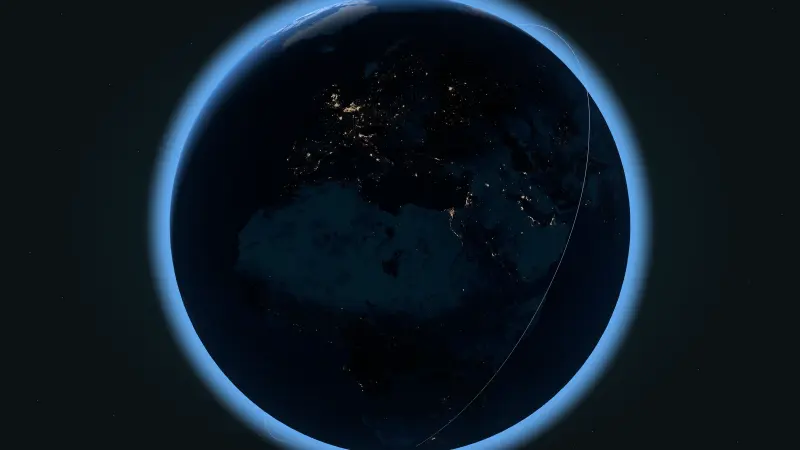
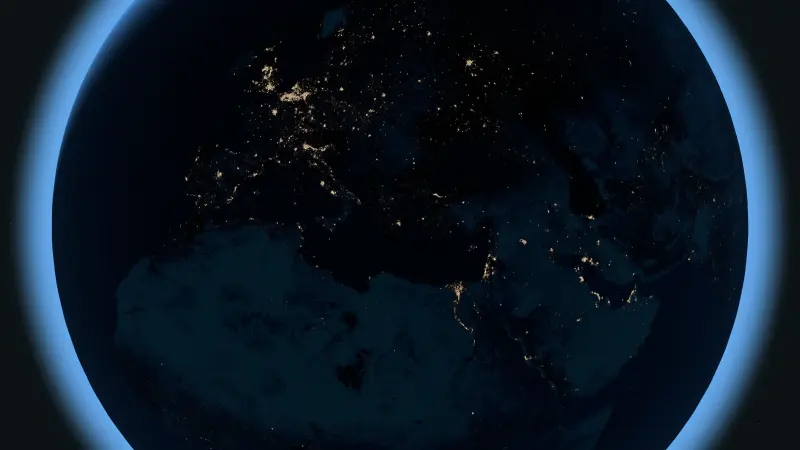
From orbit, the night side of Earth glows with city lights. Satellite images like NASA's Black Marble show where people live, how coastlines and rivers attract cities, and how dark the oceans, deserts and rainforests remain. On the EasyGeography globe, the night side uses this real imagery, lit according to the actual time. Astronauts on the International Space Station cross the terminator about 31 times a day.
Questions students ask
Why are time zones about 15 degrees wide?
Earth turns 360 degrees in 24 hours, and 360 divided by 24 is 15. So the Sun appears to move 15 degrees of longitude every hour. In practice, many time zone borders zigzag to follow countries and regions.
Why does the line between day and night look curved on a flat map?
On a globe, the terminator is a perfect circle around the planet. Flat maps stretch the world, especially near the poles, which bends that circle into a wave shape.
Is it ever day everywhere at once?
No. At any moment, very close to half of Earth is in daylight and half is in darkness.